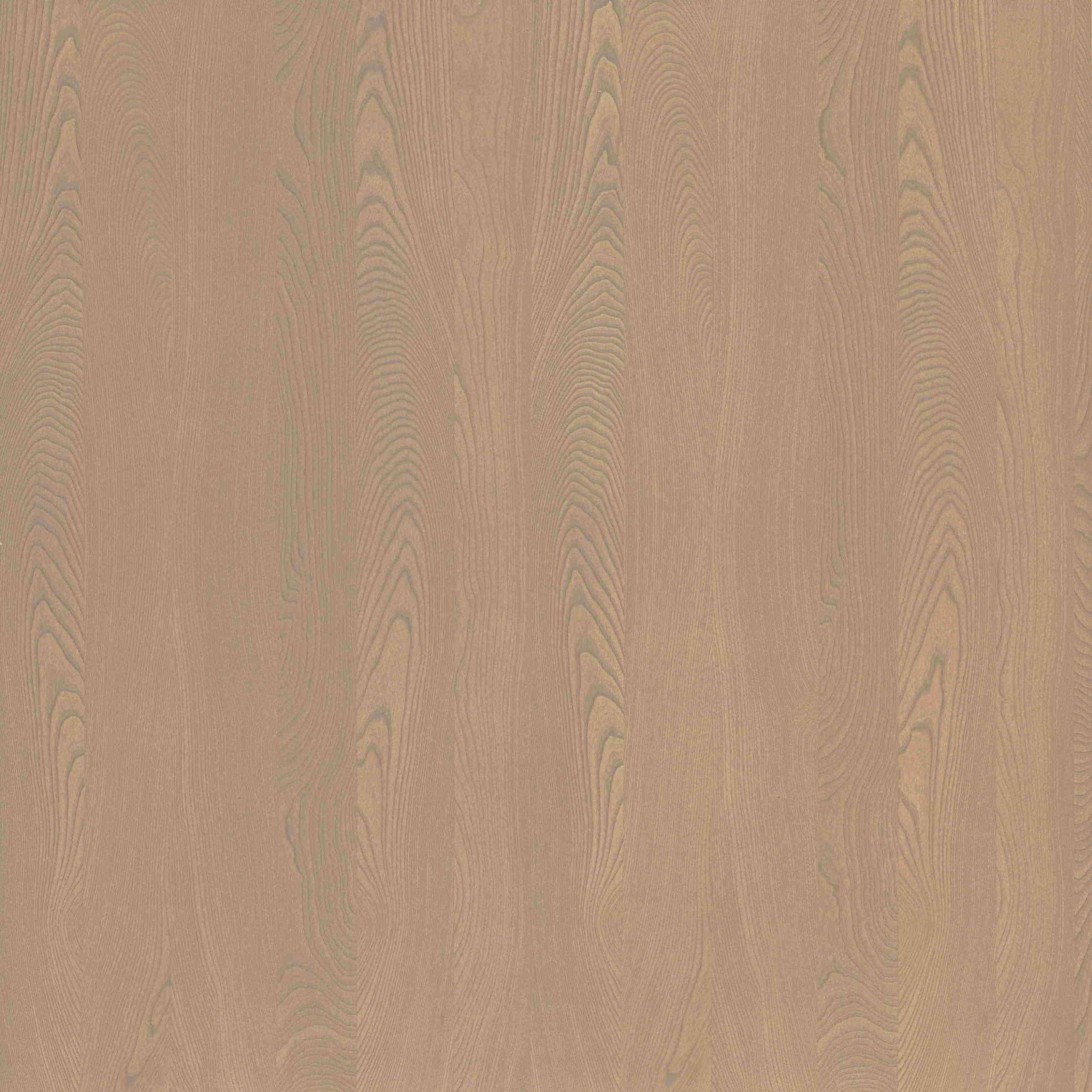
Are solid wood cabinets truly the ultimate luxury choice? For decades, American Black Walnut has stood as the gold standard in bespoke interior design. It is highly prized for its rich chocolate-brown tones, subtle purple undertones, and mesmerizing grain patterns. Yet, many homeowners and designers eventually face frustrating warping and cracking issues. Relying solely on solid wood doors in active, climate-shifting environments often leads to structural failure.
Today, premium architectural veneers effectively solve these common structural problems. They achieve this without sacrificing a single ounce of elegance. In high-end modern millwork, engineers are frequently replacing solid timber with high-quality wood slices bonded to engineered substrates. This shift is never about cutting corners. It is a deliberate engineering choice made to maximize climate stability, environmental sustainability, and absolute aesthetic control. Because not all manufacturing processes adhere to the same exacting standards, builders must navigate a complex landscape of core materials, cutting techniques, and surface treatments to make an informed decision.
This comprehensive technical guide will walk you through exactly what you need to evaluate before ordering cabinetry panels. Following these guidelines ensures your next architectural project achieves a flawless and enduring finish.
Key Takeaways
Veneer Over Solid Wood: High-quality architectural veneer is fundamentally preferred over solid lumber in luxury applications. It offers superior resistance to warping and a unique capacity to showcase continuous sweeping grain patterns.
Core Material Matters: The choice between plywood and MDF substrates depends heavily on the specific application. Builders must balance mechanical strength against flawless surface flatness.
Grain Matching Defines Luxury: The specific geometric arrangement of wood leaves ultimately dictates the visual narrative of your space.
Finish Dictates Durability: Factory-applied coatings save crucial project time and guarantee commercial-grade durability. Unfinished surfaces offer bespoke customization for unique architectural matching.
Consistency is Key: Always specify that materials must be pulled from the same flitch, meaning a single log, to guarantee strict color and texture uniformity across expansive installations.
Industry Trend Analysis: The Shift Toward Engineered Stability
Recent market analyses examining luxury cabinetry trends reveal a definitive shift away from solid hardwood carcasses. Industry data indicates a surging demand for composite wood products in high-end residential projects over the past three years. As contemporary design leans heavily into floor-to-ceiling seamless slab doors, the requirement for dimensionally stable engineered cores has skyrocketed. Architects are increasingly specifying composite substrates to comply with stricter sustainable building codes while ensuring long-term structural integrity. This transition highlights a broader industry consensus: the performance and visual perfection of a modern installation depend entirely on the hidden substrate.
The Great Debate: Solid Walnut vs. Walnut Veneer Panels
When investing in premium interior architecture, a persistent debate inevitably arises. Should custom millwork be constructed from solid American Black Walnut or engineered composite panels? To answer this objectively, we must look past outdated assumptions and examine the structural physics involved.
Busting the Cheap Veneer Myth
The lingering stigma surrounding veneered products largely stems from the mass-produced, lower-tier furniture of the late twentieth century. Those pieces frequently utilized paper-thin, low-grade wood slices haphazardly glued over low-density particleboard. This led to peeling edges and rapid deterioration. Contemporary architectural-grade materials are a completely different breed. Modern luxury manufacturing utilizes thicker slices of premium hardwood, typically ranging from 0.5mm to 0.6mm in thickness. These slices are bonded to highly engineered, dimensionally stable cores using advanced thermosetting adhesives. Far from a cost-cutting compromise, this composite approach represents the pinnacle of modern woodworking technology.
Why High-End Kitchens Actually Prefer Veneer
For bottom-of-funnel buyers finalizing their material specifications, understanding the mechanical advantages of this engineered approach is critical.
Climate Stability and Moisture Resistance
Picture a bustling kitchen environment. Boiling pots of pasta, running dishwashers, and hot ovens create frequent localized micro-climate shifts. Solid walnut is inherently hygroscopic. It constantly absorbs and releases moisture, expanding and contracting across its grain. A standard 600mm wide solid cabinet door can expand significantly during humid summer months. This results in warped faces, cracked joinery, and binding hinges. Conversely, a thin layer of wood applied to an engineered core remains dimensionally locked. The rigid substrate restricts the natural movement of the organic fibers. This ensures doors remain perfectly flat and functional regardless of seasonal humidity swings.
Aesthetic Control and Visual Continuity
Solid lumber is strictly limited by the physical dimensions of the felled tree. Sourcing solid boards wide enough to construct large seamless doors without gluing multiple mismatched pieces together is nearly impossible. Slicing a single log into hundreds of thin leaves allows manufacturers to meticulously arrange perfectly matched continuous grain patterns across an entire elevation. This is a hallmark of bespoke design that raw lumber simply cannot replicate.
Sustainable Resource Utilization
From a resource-management perspective, slicing logs is incredibly efficient. A single premium walnut tree processed into solid boards might yield just enough material for a moderately sized kitchen island. That exact same tree, when processed into architectural veneer, yields thousands of square feet of usable surface area. This maximizes the utility of slow-growing premium hardwoods and aligns luxury design with vital sustainable practices.
Comparing Core Materials: Walnut Veneer Plywood vs. Walnut MDF Panels
The core material dictates the mechanical lifespan of your cabinetry. Selecting the wrong substrate can lead to sagging hinges or telegraphing surface imperfections. Professional millworkers evaluate these cores based on tensile strength, moisture resistance, and surface uniformity.
Walnut Veneer Plywood: The Structural Champion
Constructed by bonding multiple thin layers of utility wood, such as birch or eucalyptus, in alternating grain directions, walnut veneer plywood is the workhorse of custom millwork. The premium hardwood face is pressed directly onto these cross-banded plies.
This cross-banded construction grants exceptional tensile strength and rigidity while remaining relatively lightweight. Installers highly appreciate this during complex fits. More importantly, it offers superior mechanical fastener holding capacity. Heavy-duty concealed hinges and soft-close drawer slides bite securely into the alternating wood grains. This drastically reduces the risk of hardware sagging over decades of use. It also boasts a higher natural resistance to swelling if exposed to minor plumbing leaks.
Walnut MDF Panels: The Flawless Canvas
Medium Density Fiberboard is manufactured by breaking down wood residuals into microscopic fibers, combining them with robust resin binders, and pressing them under extreme heat. The premium wood slice is then bonded directly to this ultra-dense core, creating walnut MDF panels.
Because MDF is completely isotropic, meaning it possesses no grain direction, internal voids, or overlapping layers, it provides the flattest surface physically possible in woodworking. When applying high-gloss finishes or utilizing critical raking lighting, any microscopic imperfection in a plywood core can telegraph or show through the thin wood face. MDF eliminates this telegraphing entirely. The result is a glass-smooth, visually flawless presentation that is highly stable against temperature fluctuations.
Core Selection Matrix
Performance Metric | Cross-Banded Plywood Core | Ultra-Dense MDF Core |
|---|---|---|
Structural Rigidity | Excellent | Moderate |
Surface Flatness | Good | Flawless |
Screw Holding Power | Superior | Average |
Moisture Tolerance | High | Low to Moderate |
Optimal Application | Internal structural boxes, load-bearing shelving | Visible exterior doors, large slab drawer fronts |
The most reliable engineering practice is a hybrid approach. Specify plywood for the internal structural boxes to maximize screw-holding power. Simultaneously, utilize MDF cores of standard 18mm thickness for the visible exterior doors to guarantee warp-free pristine flatness.
The Art of Grain Matching: Elevating Your Design
The defining characteristic that separates truly bespoke installations from off-the-shelf alternatives is the deliberate manipulation of the wood natural graphic. Because leaves are sliced sequentially from the log, they can be spliced together in specific geometric patterns. You must specify your preferred technique prior to fabrication.
Book Matching
As the most dramatic and highly requested technique in the luxury market, book matching involves opening successive leaves like the pages of a novel. The back of one leaf is placed adjacent to the front of the next. This creates a beautifully mirrored symmetrical pattern at the splice line. It highlights the sweeping cathedral arches of the wood. However, designers must be mindful of the barber pole effect, where alternating leaves may reflect light slightly differently depending on the viewing angle.
Slip Matching
For those seeking a sleeker aesthetic, slip matching involves sliding sequential leaves side-by-side without flipping them. Every leaf presents the same face upward. This generates a repeating pattern that entirely bypasses the mirrored symmetry and eliminates the barber pole light-reflection issue. The result is a highly uniform and consistent color tone, making it the premier choice for minimalist contemporary spaces.
Plank Matching
If the design goal leans toward rustic or organic modern styles, plank matching is ideal. Leaves from entirely different logs featuring varying widths, hues, and grain structures are intentionally mismatched and spliced together. This breaks up strict uniformity and successfully mimics the unpredictable natural variation of traditional solid lumber boards laid side-by-side.
Continuous Match
Representing the absolute pinnacle of custom interior architecture, continuous matching requires custom-manufacturing sheets to the exact dimensions of your room elevations. The natural grain flows seamlessly across multiple cabinet doors, drawer fronts, and integrated appliance covers without breaking at the seams. Achieving this requires meticulous CNC machining and pulling from a single massive log.
Prefinished Wood Veneer vs. Unfinished Panels: Making the Right Choice
The final protective coating determines your cabinetry resistance to daily abrasions, household chemicals, and moisture. Deciding whether to have materials finished at the factory or on-site by a local artisan is a critical logistical step.
The Advantages of Prefinished Materials
Ordering prefinished wood veneer is rapidly becoming the standard for high-end residential builds. Factory coatings are applied in dust-free climate-controlled environments using advanced automated spray lines.
These industrial finishes often utilize UV-cured acrylics or catalyzed polyurethanes. These coatings cure instantly under ultraviolet light to form an incredibly hard cross-linked surface. They offer vastly superior resistance to heat, moisture, and common kitchen spills compared to traditional air-dried varnishes. Furthermore, arriving ready to cut and install shaves weeks off the project schedule. This significantly reduces expensive on-site labor costs and eliminates the risk of uneven blotchy staining caused by human error.
When to Choose Unfinished Surfaces
Despite the overwhelming efficiency of factory coatings, raw panels remain indispensable for highly specific bespoke scenarios. If your project demands an exact color match to an existing antique dining table, unfinished faces provide the necessary blank canvas for a master finisher. Additionally, raw wood allows for the application of specialized low-build treatments, like hand-rubbed penetrating hardwax oils, which preserve a highly tactile organic aesthetic.
Critical Factors to Compare Before Ordering
To prevent costly fabrication errors and ensure the final installation meets rigorous architectural standards, utilize the following technical checklist when evaluating suppliers.
Veneer Cut
The angle at which the blade meets the log dictates the resulting pattern. Plain sliced moves straight across the center, producing the traditional peaking arches. In contrast, quarter sawn logs are cut radially. This yields a very straight and striped appearance highly prized in ultra-modern geometric designs.
Flitch Consistency
Because walnut is an organic material, its tones can vary wildly from creamy pale sapwood to deep purplish-black heartwood. When ordering materials for a large space, you must explicitly demand that all sheets are pulled from the exact same flitch. Mixing them will result in jarring amateurish color discrepancies.
Edge Banding Quality
Cutting a composite sheet exposes the raw plywood or MDF inner core. These exposed edges must be concealed using edge banding. Always specify matching real-wood walnut edge banding rather than cheap synthetic PVC alternatives. For luxury durability, request a thicker 1mm to 2mm band applied with high-heat Polyurethane adhesive. This creates a waterproof bond line near high-moisture zones like sinks.
Panel Thickness and Dimensions
While standard sheet goods arrive in 1220x2440mm dimensions, modern luxury design frequently incorporates oversized architectural doors that stretch to the ceiling. If your elevations exceed 2400mm, you must source oversized 1220x3050mm sheets. Attempting to horizontally join two standard sheets to reach a high ceiling creates an unsightly seam that violently breaks the grain continuity. Ensure doors utilize standard 18mm thickness for optimal hinge boring.
Sourcing and Certifications
The adhesives utilized in core manufacturing can significantly impact indoor air quality. Mandate that all materials meet strict environmental certifications, such as CARB Phase 2 or TSCA Title VI compliance. This guarantees ultra-low formaldehyde emissions.
Beyond the Kitchen: Expanding with Decorative Wall Panels
The application of premium walnut should never be isolated solely to culinary spaces. Cohesive high-end interior architecture demands a unified material palette that flows logically throughout the home.
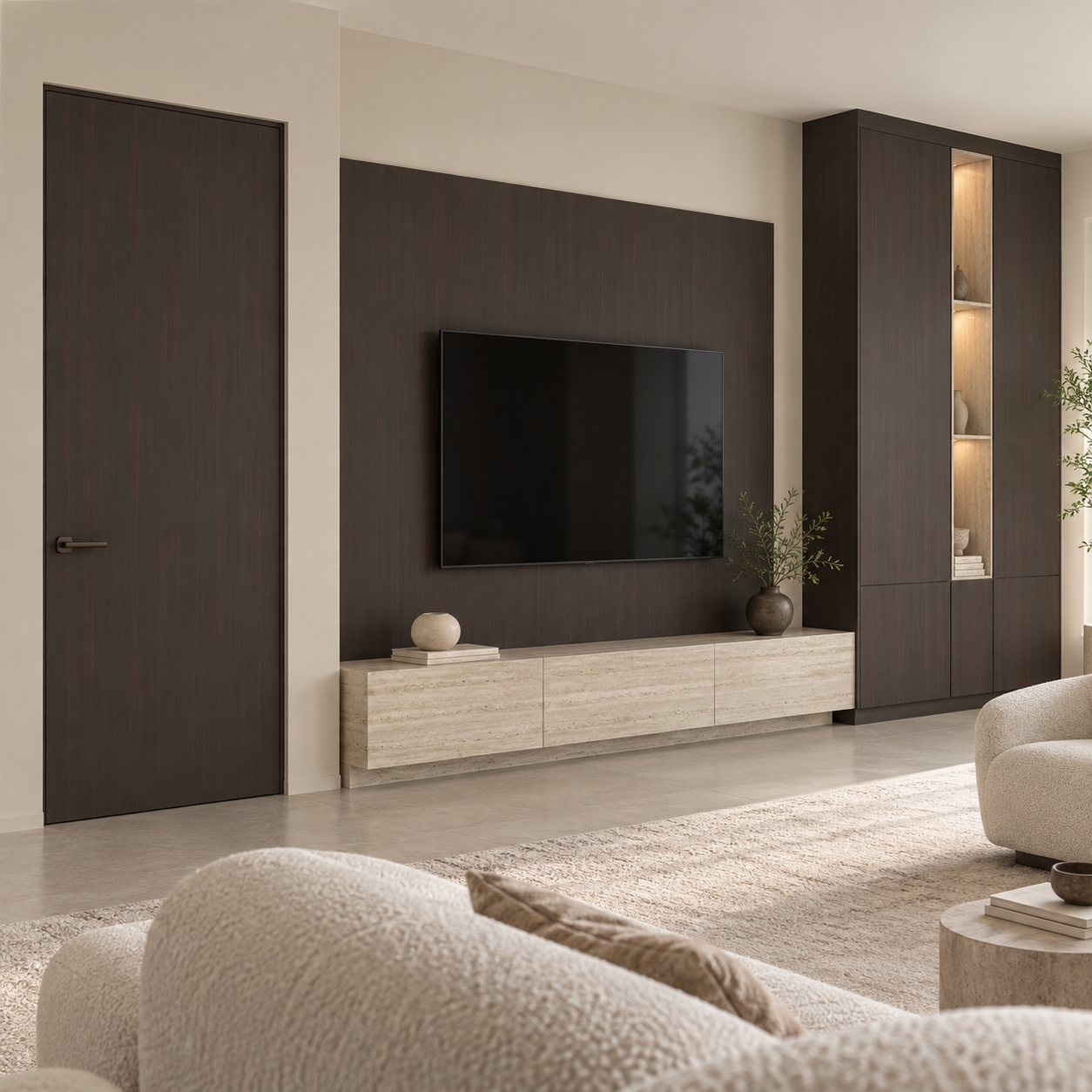
By carrying the exact same walnut flitch from the kitchen island into adjacent living spaces, designers can create expansive decorative wall panels, integrated media centers, and hidden acoustic room dividers. This seamless transition blurs the lines between individual rooms. It creates a bespoke monolithic environment that dramatically elevates the property overall architectural value.
Walnut possesses a unique chameleon-like quality. Its rich inherent warmth effortlessly bridges the gap between Mid-Century Modern nostalgia and ultra-contemporary sleekness. Whether paired with matte black steel hardware for an industrial edge or crisp white Calacatta marble for striking contrast, it adapts to anchor almost any sophisticated design narrative.
Conclusion
Choosing engineered walnut for your millwork is a highly strategic investment that brings timeless enduring luxury into your home. The secret to a flawless execution lies in the technical details. You must select the appropriate core substrate to balance structural integrity with surface perfection. You must dictate the precise grain match to set the room visual rhythm. Finally, opting for a commercial-grade finish ensures the wood withstands daily life.
For builders, architects, and homeowners ready to specify premium materials, exploring exact specifications is the next logical step. Source your architectural-grade products directly from industry-leading manufacturers like GC Panels to ensure your next custom project transitions from standard construction to a true masterpiece of interior design.
Frequently Asked Questions
Are walnut veneer cabinets durable enough for a busy kitchen?
Yes. When properly sealed or purchased with a factory-applied UV coating, they are incredibly resistant to moisture, heat, and daily abrasions. Due to their engineered cores, they often outlast solid timber doors by entirely resisting seasonal warping and cracking.
How thick is architectural grade walnut veneer?
Premium architectural grades typically range from 0.5mm to 0.6mm thick. This specific thickness provides substantial durability compared to budget paper-thin alternatives and allows for light sanding if future refinishing is required.
Is walnut veneer waterproof?
While the wood itself is not naturally waterproof, applying a high-quality catalyzed polyurethane or UV-cured finish creates a highly water-resistant barrier. Furthermore, using a moisture-resistant MDF or exterior-grade plywood core prevents structural swelling in damp environments.
Does walnut veneer lighten or darken over time?
Unlike cherry or oak which tend to darken, natural American Black Walnut actually lightens slightly over time when exposed to ambient UV light. It gradually develops a softer warm honey-golden patina that many designers highly covet.
Can you sand and refinish walnut veneer panels?
This depends entirely on the thickness of the top layer. High-quality architectural grades provide enough material to withstand at least one careful light sanding and refinishing process. Paper-thin materials found on budget furniture cannot be sanded without burning through to the core.
What is the price difference between plywood and MDF cores?
Generally, cross-banded plywood is slightly more expensive than MDF due to the higher cost of manufacturing the structural wood layers and its lighter shipping weight. However, final pricing fluctuates heavily based on the specific grade, cut, and flitch of the walnut face applied to it.
How do I clean cabinetry panels made of walnut veneer?
Daily maintenance requires nothing more than a damp soft microfiber cloth paired with a mild non-abrasive soap. It is crucial to avoid harsh chemical cleaners, heavy waxes, or silicone-based furniture polishes. These will degrade the protective clear coat and create a cloudy buildup over time.